agentic-qa-kit
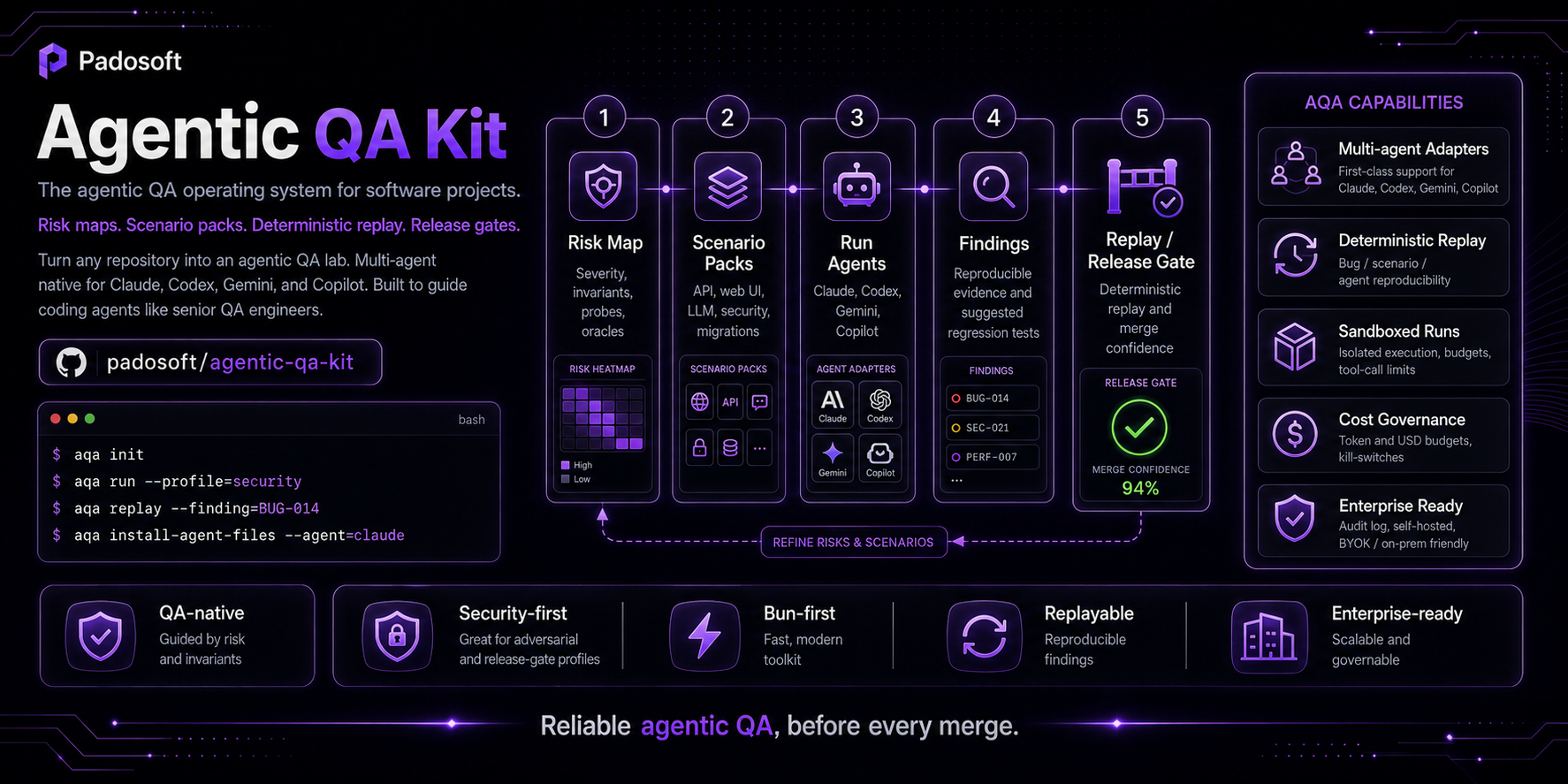






agentic-qa-kit is not a test runner — it’s an operating system for agentic QA.
A standardized framework that turns coding agents into senior QA engineers guided by risk maps,
invariants, scenarios, probes, oracles, findings and deterministic replay — reproducible,
versionable, and adaptable to every project. Bun-first, self-hosted, EU-ready.
In five minutes you’ll know exactly what this kit is, the problem it solves, why it beats every
“just run an LLM against my code” alternative, and where to click next. Every other page goes deeper —
this one gives you the whole picture.
What it is — in one minute
Coding agents — Claude Code, Codex CLI, Gemini CLI, GitHub Copilot CLI — are great at writing
code. They are poor QA engineers by default: they’ll happily ship a feature without imagining how an
attacker might abuse it, how a second tenant could leak across, or how the tool-calling layer can be
tricked into refunding a payment without confirmation.
agentic-qa-kit gives the agent the operating system it needs to behave like a senior QA engineer
on your project, and pins it to evidence instead of vibes:
- Declare what must never break — an explicit
risk-map.yamlwith severity, likelihood,
invariants, probes and oracles. Generic risks produce generic findings; your risks produce yours. - Run scenarios deterministically — pre-built packs (API, web-UI, LLM-agent, security, migrations)
executed through profiles (smoke, exploratory, security, release-gate) inside a sandbox. - Trust every finding — three-level reproducibility with bug-level deterministic replay
(repro.sh,repro.curl,repro.playwright.ts) and a hash-chained audit log you can verify.
In one line: the reusable framework that makes “ask an agent to QA my repo” operational,
reproducible, governed and multi-agent — instead of a one-off prompt.
The problem it solves
Every team pointing an agent at their codebase hits the same wall: the agent improvises, the results
aren’t reproducible, and nobody trusts the output. Here is the gap this kit closes.
| Without agentic-qa-kit | With agentic-qa-kit |
|---|---|
| You hand-write a giant QA prompt that rots, can’t be versioned, and differs per engineer. | A reusable framework — risk-map, profiles, packs and oracles — committed to the repo and shared by the whole team. |
| The agent invents what “important” means and chases generic bugs. | An explicit risk map with invariants tells the agent precisely what must never break, with severity and likelihood. |
| “It found a bug” — but you can’t reproduce it or hand it to a teammate. | Every finding ships a deterministic replay artifact (repro.sh / repro.curl / repro.playwright.ts). |
| Each tool (Claude, Codex, Gemini, Copilot) needs its own bespoke prompt and wiring. | One aqa install-agent-files writes first-class instructions + skills for all four agents with capability negotiation. |
| An agent loop quietly burns $400 overnight on tokens. | Cost governance — per-org/project/profile/scenario budgets in USD and tokens, with hard kill-switches. |
| A security probe runs straight against prod with no isolation. | Container-per-scenario sandbox by default for security/release-gate, with egress allowlists and resource limits. |
| You can’t prove to an auditor what the agent did or whether logs were tampered with. | A hash-chained audit log + WORM export, verifiable in-browser, with SOC2/ISO control mappings. |
Who it’s for
Using Claude Code, Codex, Gemini or Copilot to write code? Point the same agent at your repo as a QA engineer — guided by your risk map, not its imagination.
OWASP Top 10 Agentic (2026), STRIDE/FMEA risk discovery, sandboxed probes, egress allowlists and tool-call budgets — agentic red-teaming you can actually govern.
Hash-chained audit, WORM export, SOC2/ISO control catalog, BYOK + on-prem LLM (vLLM / Bedrock private / Azure OpenAI VNet / llama.cpp) and air-gap deploy.
A control plane (server + React admin) and a runner fleet over mTLS + OIDC — scenarios execute next to the code, so the code never leaves your perimeter.
Why it’s different — the moats
Most tools either run an LLM against your code or lint it. This kit makes agentic QA a
disciplined, reproducible, multi-agent operating model — and goes further than anything in the space.
QA starts from an explicit risk-map.yaml — categories, severity, likelihood and machine-checkable invariants. The agent tests your must-never-break rules, not generic boilerplate.
Risk → Invariant → Scenario → Probe → Oracle → Finding → Replay. Every concept is one of these seven things or a tool that operates on them — so the whole kit stays legible.
Claude · Codex · Gemini · Copilot as first-class adapters — not “Claude with the rest bolted on”. Runtime capability negotiation picks each agent’s best primitives (subagents, skills, slash commands, hooks).
Three-level reproducibility (bug / scenario / agent). The kit never lies about LLM determinism — but bug-level deterministic replay is required for any release-gate verified finding.
Container-per-scenario isolation by default for security and release-gate profiles, with egress allowlists, tool-call budgets, resource limits and cost kill-switches.
Per-org / project / profile / scenario budgets in USD and tokens, hard kill-switches and attribution to risk areas. No more “an agent loop burned $400 overnight”.
Bring your own Anthropic/OpenAI keys, or run vLLM / Bedrock private / Azure OpenAI VNet / llama.cpp. Air-gap deployment supported end-to-end.
OWASP Top 10 Agentic (2026) security pack, plus STRIDE / FMEA risk discovery, oracle ensembles and judge calibration — not ad-hoc prompting.
A hash-chained audit log + WORM export, verifiable in-browser via Web Crypto, with SOC2 / ISO 27001 control mappings and an aqa-audit-verify CLI.
agentic-qa-kit vs. the alternatives
| Capability | agentic-qa-kit | A hand-written QA prompt | Classic test runners (Jest/Playwright) | SaaS AI test tools |
|---|---|---|---|---|
| Risk-map-driven, invariant-first QA | ✅ | ➖ | ❌ | ➖ |
| Multi-agent (Claude · Codex · Gemini · Copilot) | ✅ | ➖ | ❌ | ➖ |
| Deterministic bug-level replay artifacts | ✅ | ❌ | ✅ | ➖ |
| Sandbox-per-scenario + egress allowlists | ✅ | ❌ | ❌ | ➖ |
| Cost governance (USD/token budgets + kill-switch) | ✅ | ❌ | ❌ | ➖ |
| BYOK + on-prem / air-gapped LLM | ✅ | ➖ | ❌ | ❌ |
| Hash-chained, verifiable audit log | ✅ | ❌ | ❌ | ➖ |
| Self-hosted — your code never leaves | ✅ | ✅ | ✅ | ❌ |
Legend: ✅ built-in · ➖ partial / extra cost / not exposed · ❌ not available.
How it fits together
Local mode is a single bunx aqa CLI; the optional self-hosted control plane fans the same engine out
across a runner fleet — the code never leaves its perimeter.
The pipeline every run follows:
Risk → Invariant → Scenario → Probe → Oracle → Finding → Replay
Start in 30 seconds
Install Bun and add the kit
# macOS / Linux
curl -fsSL https://bun.sh/install | bash
cd /path/to/your/project
bun add -d @padosoft/agentic-qa-kit
GitHub Packages needs a one-time
.npmrcwith aread:packagestoken — see the Installation page.Scaffold and verify the workspace
bunx aqa init        # scaffold .aqa/{project,risk-map,profiles}.yaml + testing.md
bunx aqa doctor      # green/yellow/red checklist of kit health
bunx aqa validate    # schema-check every .aqa/* file
Install agent files and run your first pass
bunx aqa install-agent-files --targets claude,codex,gemini,copilot
bunx aqa run --profile smoke   # fast, non-destructive sweep
bunx aqa report                # render report.md + report.json
bunx aqa admin                 # SPA + API on http://127.0.0.1:5173
Each finding lands with a deterministic replay artifact you can reproduce, hand to a teammate, or
attach to a PR.
→ Full Quickstart · → Installation · → Worked Example
Batteries included for AI-assisted development
This repo ships AI batteries — a CLAUDE.md working guide, an AGENTS.md operating contract and
invocable .claude/skills/ (aqa-process-loop, aqa-self-resume, docmd-docs) encoding the branch
strategy, validation gates and docs-sync discipline. Open the package in Claude Code, Cursor, Copilot
or Codex and your agent already knows the house rules.
